HSG TL3 PRO: Evaluating Mixed-Size Heavy-Tube Production
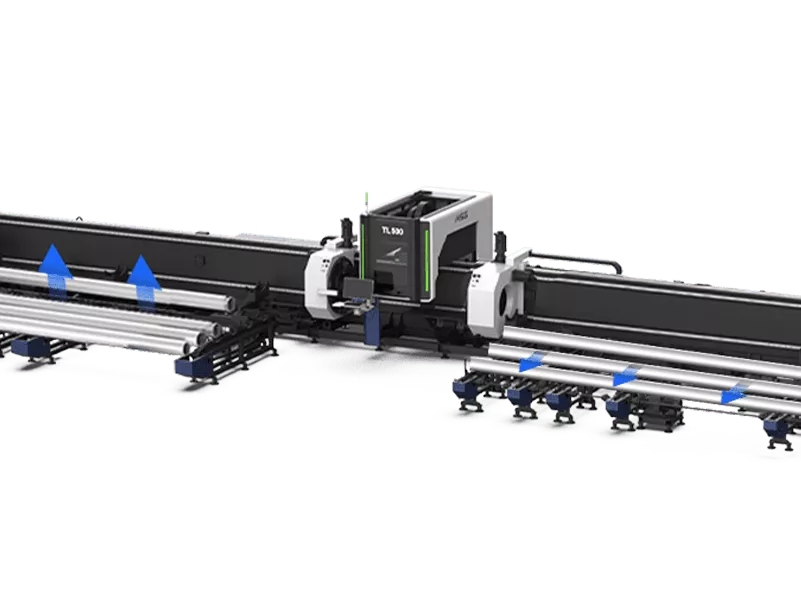
For fabricators running a mix of heavy, medium, and smaller tube, a machine that covers a broad size range may be worth evaluating. The HSG TL3 PRO combines listed round- and square-tube capacities with a design intended to load and unload while cutting. Whether that reduces handling delays or consolidates work depends on the shop’s actual material, part mix, schedule, layout, and downstream capacity.
What HSG lists for the TL3 PRO
HSG lists round-tube capacity from 20 mm to 360 mm and square-tube capacity from 20 × 20 mm to 360 × 360 mm. The company also lists a maximum single-tube load of 1,600 kg. These are manufacturer specifications; confirm the applicable configuration, material limits, and handling requirements with the supplier for the parts you intend to run.
HSG describes the machine as supporting simultaneous loading, cutting, and unloading rather than a strictly sequential cycle. In principle, overlapping material handling with cutting could reduce machine waiting time. The practical effect will depend on part lengths and weights, job sequencing, loading and unloading logistics, operator workflow, and how often the next job is ready.
Test the investment case, not just the advertised figures
HSG reports a 35.45% productivity improvement for typical 12-meter heavy-tube processing, based on its laboratory data. Its launch materials also claim up to a 35% reduction in total processing costs. These are vendor-reported figures, not independently validated results or expected savings for an individual plant. HSG states that its published specifications and test data come from its in-house laboratory.
Use those claims as hypotheses for a plant-level evaluation. Compare current production with a defined trial, using the same representative work and consistent measures. Include setup and changeover, staffing, consumables, inspection, rework, and non-cutting time. Do not assume that one machine will replace existing equipment or eliminate idle time across every job mix.
Run a representative, full-cycle trial
Choose parts that represent routine work as well as difficult examples. Include the tube sizes, weights, materials, and job mix that create real scheduling pressure. Agree on measurement methods and acceptance criteria in advance, and record exceptions rather than excluding them from the result.
Track the route from staging through loading, cutting, unloading, part identification, operator touches, and queues at the next operation. Measure elapsed time and labor from material staging through delivery to the downstream process, and compare the results with a documented baseline. Define available time, productive time, delays, and rework consistently.
Check whether deburring, fit-up, welding, inspection, and other downstream operations can absorb the output. If the laser produces parts faster than those operations can process them, the constraint may move rather than disappear. Measure any throughput change across the workflow, not from cutting time or machine utilization alone.
Plan layout, material movement, and safeguards
Review more than the machine footprint. Map incoming-stock staging, infeed and outfeed, crane coverage or other handling routes, operator access, finished-part accumulation, and clear travel paths. Confirm the proposed arrangement can accommodate actual tube lengths and weights without congestion or unsafe movement.
OSHA’s machine-guarding guidance addresses machine hazards and danger zones; its material-handling rule covers safe clearances, unobstructed aisles, and stable storage. Use these as inputs to a site-specific review with qualified safety and engineering personnel. They do not establish that a particular machine configuration or installation complies with every applicable requirement.
Include equipment placement, facility readiness, production-system integration, commissioning, operator and maintenance training, and service coordination in the project scope. These factors can affect startup stability and realized utilization as much as the machine specification.
Decide on measured workflow value
The TL3 PRO’s listed capacity, load rating, and parallel-handling concept make it a candidate for evaluating mixed-size heavy-tube work. They do not prove that it will consolidate equipment, eliminate idle time, or improve return on investment in a particular plant.
Proceed when representative testing shows enough eligible work, the full-cycle measures support the business case, material movement and safeguards are addressed, and downstream processes can handle the flow. If the result depends on ideal sequencing or leaves out handling time and queues, refine the trial before committing.
For complex installations, I help teams coordinate layout, integration, commissioning, training, and measurable acceptance criteria so the investment is assessed as part of the full production system.
Related Video
HSG TL 4 chuck heavy tube laser cutting machine by Mac Tech, supports up to 715mm