Automation Pairing Trends for Fiber Lasers in Labor-Constrained Fabrication Shops
Labor Reality in Upper Midwest Fabrication
I spend a lot of time in shops across Wisconsin, Minnesota, and North Dakota. The conversation is consistent. The laser itself is not the problem. Keeping it fed on second shift is.
Trade coverage from Manufacturing.net continues to highlight tight labor conditions and the push toward automation across U.S. manufacturing. In our region, that pressure shows up as open second-shift operator roles, material handling bottlenecks, and experienced team members nearing retirement.
For most production managers I work with, the goal is not to eliminate people. It is to stabilize throughput when staffing is thin, reduce overtime, and protect delivery dates when someone calls in sick during a snowstorm.
What Automation Pairing Means in 2026
Automation pairing is simply connecting your fiber laser to the right level of material handling and part flow so it can run consistently without constant manual intervention.
OEMs like Salvagnini and Prima Power both outline modular laser systems that scale from basic shuttle tables to integrated storage towers and flexible manufacturing cells. The common theme is staged adoption. You do not have to jump straight to a full lights-out system.
At a practical level, pairing can include:
- Dual shuttle tables for faster sheet changeover
- Automatic load and unload devices
- Compact storage towers tied directly to the laser
- Robotic part sorting or machine tending
- Integrated cells that connect cutting to storage and downstream flow
FANUC America documents how robotic machine tending is being used across manufacturing to load, unload, and handle parts with repeatability. In a laser environment, that translates into automated part removal, sorting, and stacking so operators are not babysitting skeletons.
Phased Upgrade Path for Existing Fiber Laser Owners
Most shops I work with already have a fiber laser with a manual shuttle table. The question is how to upgrade without disrupting production.
Phase 1: Optimize the manual shuttle.
Standardize sheet staging lanes. Tighten nesting. Improve cut scheduling so material thickness changes are grouped. This alone can free up capacity without capital expense.
Phase 2: Add automated load and unload.
This removes the constant forklift dance. The laser changes sheets automatically, and an operator can supervise instead of physically loading every cycle.
Phase 3: Integrate a compact tower.
Salvagnini and Prima Power both show examples of towers directly connected to the laser. A tower lets you stage multiple materials and thicknesses in a small footprint. For high-mix shops, this is where second-shift stability really improves.
Phase 4: Robotic sorting and downstream flow.
Using robotic tending concepts like those outlined by FANUC, parts can be sorted by job, palletized, or transferred to carts in cut order. This reduces manual sorting time and protects part identification.
Each phase should be justified by workload. I encourage managers to treat automation as risk reduction and throughput protection, not a one-time leap.
Footprint, Utilities, and Winter Reliability Planning
In the Upper Midwest, facility planning is not just about square footage. It is about how the system behaves in January.
Before adding towers or robotics, evaluate:
- Ceiling height for tower systems
- Floor loading and anchor requirements
- Electrical capacity and clean power
- Assist gas supply and storage
- Fume extraction sizing for higher utilization
- Dedicated material staging lanes to avoid forklift congestion
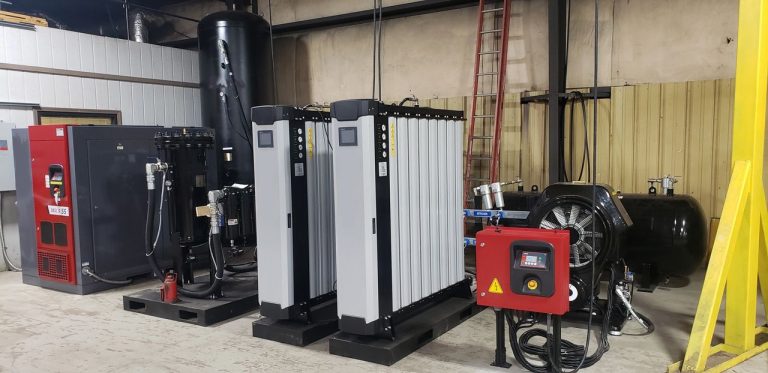
Winter reliability often gets overlooked. Cold-soaked material can introduce condensation when brought inside. Compressed air quality becomes critical when moisture increases. Snow and ice impact dock scheduling and raw material delivery timing.
I advise shops to look at dryer capacity on compressed air systems, confirm HVAC stability around automation controls, and plan clear forklift routes so tower loading is not interrupted during storms.
ROI Modeling: Utilization, Overtime, and Throughput Protection
Automation ROI should not be framed as headcount reduction. It should be modeled around three measurable factors.
Laser utilization.
If your laser is idle waiting for material, automation increases actual cutting time per shift.
Overtime reduction.
When sheet change and sorting are automated, you reduce the need to extend shifts just to clear backlogs.
Throughput stability.
Consistent material flow protects due dates and reduces expediting chaos.
Manufacturing.net reporting shows manufacturers are investing in automation to offset labor constraints and improve consistency. In fabrication, that often translates into protecting machine output rather than replacing operators.
Every shop is different. A high-mix job shop will see benefits in flexibility and reduced changeover friction. A heavier fabrication operation may value consistent thick-plate processing and safer handling.
Connecting the Laser to Press Brakes and Lean Forming Cells
Laser automation only pays off if forming can keep up.
I push production managers to look at the laser and press brakes as one system. That means:
- Standardized carts sized to typical blank dimensions
- Cut-order sorting so parts arrive at the brake in sequence
- Offline programming alignment between flat patterns and bend programs
- Visual scheduling boards or MES integration to reduce WIP
When blanks leave an automated laser cell already sorted by job and thickness, press brake setup becomes more predictable. That supports lean forming cells and reduces piles of work in process between departments.
Practical Next Steps for Production Managers
If you are evaluating automation pairing for your fiber laser, start with a clear picture of your current bottleneck. Is it sheet loading, part sorting, second-shift staffing, or brake backlog?
Then map a phased path that fits your building, your winter conditions, and your staffing model. Review OEM automation options from companies like Salvagnini and Prima Power, and evaluate robotic tending concepts from FANUC in the context of your part mix.
Automation does not have to be all or nothing. In most Upper Midwest shops I visit, the winning strategy is steady, modular upgrades that protect throughput, reduce manual strain, and keep production steady when labor is tight.
With the right plan, your fiber laser becomes more than a fast cutter. It becomes a stable, integrated production asset that supports the entire fabrication workflow.
Related Video
ERMAKSAN Towermak 4 Automatic Laser Loading Unloading Tower System