Why Ermaksan Tandem Press Brakes Are Optimal for Tier-One Metal Fabrication Operations
In the fast-paced world of tier-oneIn the fast-paced world of tier-one metal fabrication, production managers are constantly seeking ways to deliver high-quality results on demanding schedules with streamlined workflows and reliable machine performance. Investing in equipment is not just about today’s output. It’s about choosing solutions that foster long-term growth, reduce bottlenecks, and help teams meet tighter tolerances with less stress on both operators and equipment. Ermaksan Tandem Press Brakes, renowned for their advanced engineering and intelligent design, stand out as a strategic answer for operations aiming to elevate their standards in efficiency, precision, and profitability where every part, hour, and dollar counts.
Maximizing Productivity with Tandem Configuration Technology
Tandem press brake configurations enable operations to run two synchronized press brakes together, doubling the working length and expanding production capacity. For shops routinely handling oversized or complex parts—think long beams, panels, or cabinetry—this setup means one machine per part, fewer setups, and minimal repositioning. Ermaksan Tandem systems are expertly designed for easy switching between tandem and independent mode, providing a flexible setup for fluctuating workloads.
Sales-driven insight shows Ermaksan’s tandem flexibility helps meet customer demands for oversize parts without outsourcing or splitting the job, keeping quality and turnaround in-house. Their Power-Bend Pro and Evolution series come highly recommended for operations seeking robust build quality and tie-rod synchronization, ensuring consistent results across the full working length.
Logistically, using one tandem system instead of two side-by-side units reduces material handling, frees up valuable floor space, and simplifies the assembly line. This direct integration into progressive manufacturing processes cuts down on transportation time between machines and enables shops to scale their output with less labor—key for shops tackling large numbers of long or intricate parts.
Enhancing Precision through Advanced CNC Control Systems
Modern fabrication demands tight tolerances and repeatable results. Ermaksan Tandem Press Brakes feature state-of-the-art CNC controls, allowing operators to program complex bending sequences with confidence. The Delem DA66T and Ermaksan’s ESA S660W control panels are easy to use, even for operators new to advanced automation.
From a productivity standpoint, CNC automation minimizes manual intervention, reduces the risk of human error, and ensures that every piece—whether part of a short run or larger batch—meets the same high standards. Machine recommendations for teams prioritizing precision would be Ermaksan’s Power-Bend Pro Tandem, which integrates high-resolution linear encoders and real-time feedback for optimal accuracy.
For operations, fewer mistakes on the floor mean less rework, less wasted material, and a smoother process from start to finish. Reducing setup times and allowing for quick file recall are efficiency boosters for both seasoned and new staff, ensuring your throughput stays high even if you’re training new hires or rotating operators.
Streamlining Large-Scale Fabrication with Extended Bending Lengths
One of the standout features of Ermaksan Tandem Press Brakes is their ability to handle parts with extended bending lengths—up to and beyond 20 meters when two or more brakes are linked. Fabricators can form exceptionally long, precise components in a single pass, eliminating the need for multiple setups or tricky part alignments that can introduce errors and inefficiencies.
From a logistical perspective, long-bed tandem press brakes streamline material handling. Large parts can be placed, bent, and moved in fewer steps. This lessens the risk of surface damage and labor-intensive repositioning, and fits nicely into assembly lines where speed and accuracy are crucial. Ermaksan’s Power-Bend Pro Tandem and Evolution Tandem are recommended for such scenarios, especially when fitted with heavy-duty backgauges and support arms for proper material support.
For high-volume shops, this capability translates directly to lower production costs and faster order fulfillment. Customers with demanding size requirements will be drawn to partners who can confidently manufacture—and guarantee—one-piece, full-length components, helping your operation grow its reputation and book of business.
Improving Safety and Ergonomics for High-Volume Operations
Safety features are a cornerstone of Ermaksan’s design philosophy. Tandem systems are built with integrated light curtains, advanced laser safety scanners, and fail-safe hydraulic systems. These features safeguard operators while maintaining a smooth workflow and allow for high-throughput operations without compromising on safety or ergonomics.
With improved ergonomics comes reduced fatigue and injury risk, which is invaluable in high-production shops. Adjustable front support arms and ergonomic controls allow operators to handle larger parts comfortably, which boosts morale as well as productivity. Ermaksan’s customizable safety systems also allow you to tailor the machine to your shop’s specific requirements—a key point for operations handling a variety of part sizes and shift patterns.
Efficient personnel flow means less time spent lifting, turning, or walking parts across the shop, further reducing delays and physical strain on your team.
Lowering Operational Costs through Energy-Efficient Hydraulic Systems
Energy efficiency is increasingly important as margins get tighter and sustainability standards rise. Ermaksan addresses this by incorporating variable-speed hydraulic systems into their tandem models, which only consume electricity as needed. This not only lowers monthly energy bills but also minimizes heat generation and wear on system components, extending machine life and reducing maintenance costs.
Sales insights show that these energy-efficient systems can cut operating costs by a significant margin—sometimes as much as 45 percent compared to older, fixed-pump machines. For managers aiming for ISO certifications or green initiatives, Ermaksan machines help satisfy environmental policies as well.
Model recommendations like the Power-Bend Pro Tandem with Eco-Bend hydraulic package provide a sweet spot of reliability, reduced oil usage, and quick response. Less frequent maintenance, lower heat output, and smaller carbon footprints offer a very practical and appealing solution for shops with high production demands.
FAQ
What are the main benefits of using Ermaksan Tandem Press Brakes for my operation?
You gain increased capacity for longer and more complex parts, better workflow efficiency, and higher precision—all critical for the demands of tier-one fabrication.
How much training is required to operate the CNC controls?
Ermaksan’s touch-screen CNC controls are intuitive; most teams get up to speed quickly, especially with support from the manufacturer or distributor.
Will this investment really reduce material handling?
Yes, tandem brakes allow for single-piece forming, so you eliminate double-handling and awkward transfers, leading to less damage and lower labor costs.
Can these brakes be used independently or must they always be run together?
You can operate each press brake independently or in tandem mode, giving you unparalleled flexibility for both small and large jobs.
Are there ongoing cost savings beyond just energy reduction?
Definitely. You’ll also see savings from fewer repairs, less hydraulic wear, less downtime, and reduced scrap or rework thanks to better part quality.
What support is available for installation and technical questions?
Ermaksan has a robust distributor and technical support network to assist with installation, training, and after-sales service.
Investing in Ermaksan Tandem Press Brakes means equipping your shop with equipment built for growth, precision, and reliability. By tackling the challenges of large-part production, tight tolerances, shop safety, and rising operational costs, these machines are an asset that pays for itself in throughput and efficiency, keeping your team ahead in the competitive world of tier-one fabrication. If your goal is to work smarter—not just harder—these solutions are worth a close look.
Ready to explore how Ermaksan Tandem Press Brakes can elevate your shop’s productivity and quality? Reach out to your authorized Ermaksan distributor or technical team for a personalized consultation and get solutions tailored to your operation’s needs.
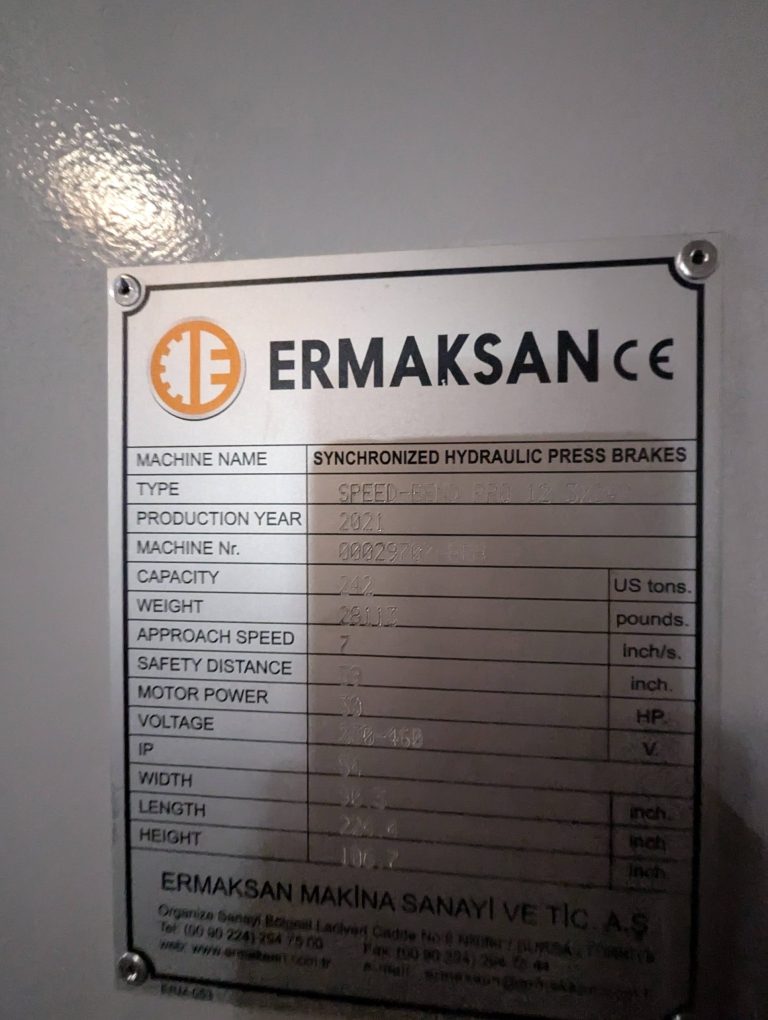
Ermaksan tandem press brakes combine two synchronized press brake machines to handle long, complex, and high-volume bending work, making them well-suited to tier-one metal fabrication where accuracy, throughput, and flexibility are critical.
At a Glance
- Designed for high-end, tier-one metal fabrication environments requiring long parts and tight tolerances.
- Tandem configuration allows two press brakes to operate together for extra-long bends or independently for standard jobs.
- CNC control enables programmable angles, backgauge positions, and bending sequences for repeatable quality.
- Ideal for large panels, structural components, and chassis parts where single-machine bed length is insufficient.
- Supports smart fabrication workflows by integrating with upstream design and downstream inspection processes.
Budgeting & Pricing
Typical investment range: $250,000 – $900,000 USD depending on tonnage, bed length, control package, and automation options.
- Expect lower end of the range for shorter beds, moderate tonnage, and basic CNC controls without automation.
- Higher pricing is associated with longer combined bending length, higher tonnage, and advanced CNC systems.
- Additional cost drivers can include front/rear sheet supports, angle-measuring systems, and tool change aids.
- Budget for tooling (punches/dies) separately; complex part families typically require multiple tool sets.
- Factor in installation, commissioning, and operator training as part of the total project cost.
- Consider lifetime operating cost: energy usage, tooling wear, and scheduled maintenance over many years of production.
Performance / Spec Considerations
- Combined bending length: Tandem setups are chosen primarily to achieve long bed lengths; confirm that the total working length and each individual machine length match your largest panel and part sizes.
- Tonnage capacity: Ensure available tonnage supports your maximum material thickness, grade, and bend length, especially for high-strength steels common in tier-one work.
- CNC control & synchronization: Look for precise synchronization between the two machines, multi-axis control of backgauges, and user-friendly programming for complex part geometries.
- Backgauge configuration: Number of controlled axes, stroke, and speed of the backgauge directly affect part accuracy and changeover time in high-mix production.
- Deflection compensation: Crowning and compensation systems are important to maintain consistent angles along very long bends across both machines.
- Setup and changeover efficiency: Quick tool clamping, reference systems, and program recall are key to keeping high-value tandem capacity productive across multiple jobs.
- Integration potential: Evaluate how the tandem press brakes will interface with your existing CAD/CAM, ERP, and quality systems to support “smart fabrication” and data-driven operations.
Pre-Purchase Checklist
- Confirm required maximum bend length and whether it must be achieved in tandem mode or on a single machine.
- Verify tonnage requirements for your thickest and strongest materials at full working length.
- Review CNC control functions for multi-axis backgauge, program storage, and ease of use for your operators.
- Inspect available crowning/deflection compensation features and how they work across both machines in tandem.
- Assess tooling compatibility with your existing punches/dies or plan for new tooling packages.
- Check floor space, foundation requirements, and access for installation and future maintenance.
- Evaluate safety systems, guarding, and compliance with relevant local and industry regulations.
- Discuss training, commissioning support, and documentation to bring operators up to speed quickly.
- Clarify service response expectations, spare parts availability, and recommended maintenance intervals.
- Run sample parts or simulations of your most critical jobs to validate achievable accuracy and cycle times.
Common Questions
How does a tandem press brake differ from a single long-bed press brake? A tandem system uses two synchronized press brakes that can work together for long parts or separately for shorter work, offering more flexibility than a single long-bed machine of similar total length.
Why are tandem press brakes suited to tier-one metal fabrication? They support long, complex, and high-precision parts with repeatable accuracy and high throughput, which aligns with the quality and volume demands typical of tier-one contracts.
What drives the price range from $250,000 to $900,000 USD? Key drivers include total bending length, tonnage, sophistication of the CNC and backgauge systems, and any added automation or support options.
Can the machines in a tandem setup be used independently? Yes, tandem configurations are typically designed so each press brake can operate on its own for shorter parts, improving utilization when long-bend jobs are not running.
How important is CNC control sophistication in a tandem system? It is critical, as the control manages synchronization between machines, multi-axis backgauges, and complex bend sequences needed for consistent, high-quality output.
What should I know about tooling for tandem press brakes? You will need tooling that covers the full part range and supports long, continuous bends; planning for standardization and quick changes can significantly reduce downtime.
How do tandem press brakes support “smart fabrication” initiatives? They can be integrated into digital workflows where programs, production data, and quality results are shared across design, planning, and inspection systems for better control and traceability.
Are there special installation considerations? Yes, tandem systems require adequate floor space, proper alignment, and attention to foundation and access, all of which should be planned before purchase.
What maintenance needs should I expect? Routine maintenance typically includes inspection of hydraulic, mechanical, and control components, along with calibration checks to maintain accuracy over the full bending length.
How do I verify that a tandem press brake can handle my parts? Provide representative drawings and material data, and request sample bends or simulations to confirm that length, tonnage, and accuracy requirements can be met.
Source: Why Ermaksan Tandem Press Brakes Are Optimal for Tier-One Metal Fabrication Operations
Why Ermaksan Tandem Press Brakes Are Optimal for Tier-One Metal Fabrication Operations