Structural Fabrication Solutions for Streamlining Operations in Metalworking Facilities
Every successful metal fabrication shop rests on the shoulders of hardworking teams that demand both efficiency and technical excellence. Meeting tight production schedules while maintaining high quality isn’t just about hard work; it’s equally about smart choices—choosing solutions that make the floor run smoother, safer, and faster. Today’s best-performing facilities are not just factories, but agile, tech-driven operations adopting integrated systems and modern machinery designed to solve real-world metalworking challenges. Here’s how you can take your shop’s structural fabrication to the next level by introducing advanced technologies and proven processes.
Integrating Advanced CAD and CAM Technologies for Precision Fabrication
Precision starts at the design desk. Computer-Aided Design (CAD) systems have become the nerve center for layout, detailing, and error-free modeling in modern fabrication. Integrating CAD with Computer-Aided Manufacturing (CAM) means your shop can move from concept to finished parts with fewer hiccups—a game-changer for production managers dealing with short turnarounds and complex assemblies.
Using advanced CAD/CAM software, such as those paired with structural steel processing machines, lets you automate nesting, cut lists, and tool paths tailored to your specific materials and job requirements. This reduces manual input and miscommunication between design and shop floor, slashing the chance of costly mistakes.
From a sales solution standpoint, investing in integrated design-to-fabrication packages like those compatible with PythonX or Voortman beam lines can centralize control of plasma, drill, and saw processes. These systems offer technical advantages: real-time data transfer, 3D visualization, and error-checking, ensuring precise cuts and drilled holes—saving hours on layout, rework, and material waste.
Technically, managers should require compatibility between CAD/CAM setups and structural machinery, ensuring seamless data flow. Logistically, progressive assembly processes are simplified since parts are manufactured to tighter tolerances, reducing mismatch during assembly and minimizing extra handling.
Implementing Automated Material Handling Systems to Reduce Downtime
Manually moving beams, sheets, or profiles eats up valuable production time and puts workers at risk of injury. Automated material handling solutions revolutionize how metal moves from staging to machines and finally to shipping, greatly reducing downtime between operations.
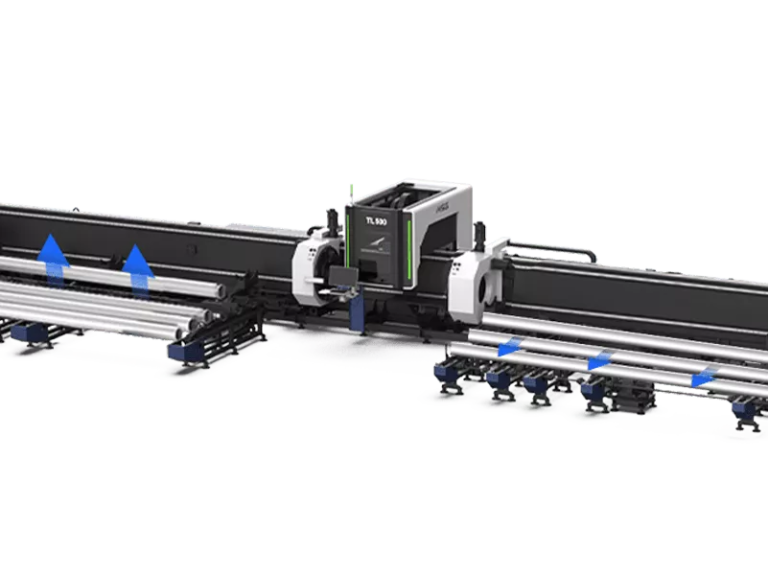
Material handling solutions like automated conveyors, cross-transfer tables, and robotic loaders (such as those equipped with the PythonX or Daito structural fabrication centers) keep materials flowing efficiently. Sales insight: Adding these automated systems can save hours per shift, pay for themselves in labor cost reductions, and help meet tight delivery targets.
From a technical and logistical perspective, programmable lifting arms, stackers, and transfer carts reduce the number of times an operator touches the material. Machine recommendations should fit your layout—modular roller bed conveyors for long beams, overhead cranes for heavy jobs, and smart storage racks for staging. Your assembly process becomes more progressive, with stations arranged for sequential operations, so handling is kept to a minimum.
Leveraging Modular Fabrication Techniques for Enhanced Flexibility
Traditional “one-size-fits-all” fabrication can slow down your operation, especially when tackling different job types or custom projects. Modular fabrication means breaking down structures into standardized segments or kits, allowing parallel production and easier assembly on-site.
Sales-wise, shops that can take on a wider range of jobs without costly retooling are more competitive and can offer faster turnaround. Leveraging equipment that supports modular work—like CNC beam drilling with auto-tool changers and plasma coping stations—means small batch runs or design changes don’t paralyze your line.
Progressive assembly is simplified: sub-assemblies are manufactured and prepped at different cells, then moved together for final welding or bolting. This cuts material handling, reduces floor clutter, and lets your team work on several parts of the project at once. Requirements for such flexibility include multi-axis CNC machines, indexing tables, and quick-change fixturing systems that are scalable and easy to reconfigure as projects shift.
Optimizing Welding and Joining Processes for Greater Efficiency
Welding and joining are the backbone of structural fabrication, but they’re also bottlenecks. Automated welding solutions like robotic welders or semi-automatic systems can increase output and provide more consistent quality than manual welding for repeatable processes.
Investing in machines such as automated beam welding lines, submerged arc welders, or robotic cells (like those offered by Voortman or Peddinghaus structural lines) drastically cuts cycle times. With programmable settings and quick changeover, operators can handle multiple job types without extensive retraining.
Sales solutions here focus on reducing rework and inspection time by ensuring every fillet, groove, or connection meets standard from the first pass. Technically, you’ll want integrated weld seam tracking, fume extraction, and safety enclosures. From a logistical standpoint, minimizing movement between welding and assembly stations, and combining operations where possible, yields a leaner workflow with less material handling.
Ensuring Quality Control Through Real-Time Monitoring and Inspection
Quality can’t be an afterthought—it needs to be built into every step. Real-time inspection and monitoring systems ensure that defects are caught before they reach the next stage, saving both time and costly rework.
Laser measurement tools, on-machine vision systems, and non-destructive testing gear (NDT) can be integrated directly with cutting, drilling, and welding equipment. This allows for immediate feedback, so operators can make adjustments before issues compound. Sales benefits here include fewer warranty claims and the ability to charge premium rates for documented quality.
Technical requirements focus on compatibility with your existing machines and infrastructure. Logistically, automated data logging and part tracking systems provide full traceability for every piece fabricated, an advantage especially for critical infrastructure or government projects. The right inspection tools enable a progressive assembly where only in-tolerance parts move forward, eliminating bottlenecks and piles of rejected work.
FAQ
What is the main benefit of automating material handling in my shop?
Automation speeds up production, reduces labor costs, and improves safety by limiting manual lifting and carrying.
How does integrating CAD/CAM improve my operation?
It minimizes errors and rework, speeds up part programming, and ensures parts are fabricated precisely to design with minimal manual input.
Can modular fabrication work for custom projects?
Yes, it’s flexible enough for custom work since standardized modules can be adapted or combined as needed, reducing lead time and shop space usage.
Are automated welding solutions a big investment?
Initial costs can be significant but pay off quickly in increased throughput, reduced labor needs, and improved consistency/quality.
What machines are best for structural steel fabrication?
Look for multi-process CNC structural lines, robotic welders, automated conveyors, and integrated inspection devices suited to your operation’s size and production mix.
Does real-time inspection slow down production?
No, it actually reduces delays by catching errors early, so less rework is needed later in the process.
Every shop faces its own daily challenges, but the best structural fabrication solutions come from a clear blend of technology, smart process design, and a relentless focus on quality and efficiency. There’s never been a better time to bring these solutions to your floor. For more details on the specific machines, systems, and vendors, check out resources like Mac-Tech (mac-tech.com) for practical advice and product options tailored to your needs.
Ready to streamline your operations? Reach out to industry experts and take the next step towards a more efficient, competitive metalworking facility.
Structural fabrication solutions in metalworking facilities combine automated cutting, drilling, welding, and material‑handling systems to turn beams, columns, plate, and tube into finished structural components with higher throughput, lower labor content, and more consistent quality.
Overview
- Structural fabrication systems typically integrate processes such as sawing, thermal cutting, drilling, punching, coping, and welding for steel profiles and plate.
- Modern layouts emphasize flow: raw stock in, sequenced structural parts out, with minimal handling and bottlenecks between stations.
- Automation (CNC controls, programmable stops, nesting software, conveyors) reduces set‑up time and manual measuring, improving repeatability.
- Smart solutions focus on synchronizing design data (e.g., from detailing software) with shop equipment to reduce rework and manual data entry.
- Material handling—roller conveyors, transfer tables, and bundle handling—often has as much impact on throughput as the cutting and drilling equipment itself.
- Right‑sizing capacity to the mix of beams, channels, angles, and plate processed daily is critical to avoid underutilized or overloaded equipment.
Budgeting & Pricing
Pricing estimate (USD): Varies by configuration, level of automation, and the specific structural processes integrated (cutting, drilling, coping, welding, handling).
- Entry‑level solutions may focus on a single operation (e.g., a structural band saw or basic beam drill line) with manual material handling to keep capital outlay down.
- Mid‑range configurations often add CNC controls, automatic length measurement, and powered infeed/outfeed conveyors to reduce labor per ton.
- High‑throughput lines with multiple integrated processes and automated sorting/stacking can represent a significantly higher investment but are justified by tonnage and labor savings.
- Budgeting should include not just the machine price, but also foundations, utilities, tooling/consumables, operator training, and software integration.
- Facilities upgrading from manual to semi‑automated systems should model savings in setup time, scrap reduction, and rework when comparing options.
- Lifecycle costs—maintenance, wear parts, and potential downtime—often differ more between configurations than the initial purchase price.
Specs That Matter
- Profile and plate capacity – Maximum beam depth, flange width, and wall thickness, plus plate thickness and width ranges that can be processed efficiently.
- Process envelope – Whether the solution covers sawing, drilling, punching, coping, thermal cutting, and marking in one flow or requires separate stations.
- Throughput and cycle time – Tonnes per shift or pieces per hour at typical job‑mix; consider small/medium sections versus occasional large members.
- Automation level – Degree of CNC control, automatic positioning, tool change, material feeding, and part sorting to minimize manual intervention.
- Material‑handling integration – Roller conveyors, cross‑transfers, buffer zones, and load/unload stations that match upstream and downstream processes.
- Software and data integration – Ability to import part data, nesting/optimization features, and traceability/marking options for project documentation.
- Footprint and layout flexibility – Space required, orientation options, and how easily the system can be reconfigured as product mix or volume changes.
Pre-Purchase Checklist
- Confirm that the capacity envelope (section sizes, plate thickness, lengths) matches or exceeds the largest members you expect to process routinely.
- Map your current workflow and identify bottlenecks to ensure the new solution actually addresses the most time‑consuming steps, not just isolated tasks.
- Evaluate automation features against your labor skill levels and availability, balancing ease of use with the complexity of your typical projects.
- Review material‑handling requirements, including loading, in‑process buffering, and finished‑part staging, to avoid simply moving the bottleneck.
- Assess software compatibility with your existing detailing, nesting, and production‑planning tools to reduce manual data entry and errors.
- Inspect build quality, guarding, and safety features, and verify compliance with relevant safety standards and your internal policies.
- Ask for realistic throughput data on parts similar to your work, including changeover times between different profiles and thicknesses.
- Clarify maintenance needs, recommended service intervals, and availability of local technical support and spare parts.
- Plan for utilities (power, compressed air, extraction if applicable) and any floor or foundation work required before installation.
- Include operator and maintenance training in the project scope so the system can reach its intended productivity quickly after commissioning.
Buyer Questions
How do I size a structural fabrication solution for my shop? Start from your typical and peak section sizes, tonnage per month, and product mix, then select equipment that comfortably handles the largest members while remaining efficient on your most common profiles.
Can I upgrade from manual processes in stages? Yes, many facilities move first to semi‑automated cutting or drilling with basic conveyors, then add more automation and integrated processes as volume and budgets grow.
What impact does automation have on labor needs? Automation usually reduces the number of people needed at each station and shifts the skill requirement toward programming, setup, and oversight rather than manual measuring and handling.
How important is software integration with detailing models? Direct data transfer from detailing or design software to shop equipment can significantly cut errors and rework by eliminating manual transcription of dimensions and hole patterns.
What should I look for in material‑handling design? Ensure that infeed, outfeed, and transfer systems are balanced with machine throughput and allow accumulation, sorting, and safe handling of long heavy members.
Do I need a fully integrated line for smaller projects? Not necessarily; smaller or job‑shop operations may benefit more from flexible stand‑alone machines that can be rearranged as project types change.
How do these solutions help reduce scrap and rework? CNC positioning, automated measuring, and data‑driven programming improve accuracy and repeatability, which typically reduces cutting errors, mislocated holes, and fit‑up problems.
What are common hidden costs to consider? Foundation work, electrical upgrades, dust or fume extraction where needed, tooling and consumables, and the time required for training and process changes can all add to the project cost.
Can one system handle both heavy structural and lighter fabrication? Many structural solutions can process a range of sizes, but you should verify that cycle times and handling are efficient for smaller sections if they make up a large share of your work.
How long does it take to realize productivity gains? The ramp‑up period depends on training and how much your workflows change, but planning data integration and operator training early usually shortens the time to full productivity.
Source: Structural Fabrication Solutions for Streamlining Operations in Metalworking Facilities
Structural Fabrication Solutions for Streamlining Operations in Metalworking Facilities