Revolutionizing Industry: Fiber Laser Cutting’s Rise
Revolutionizing Industry: Fiber Laser Cutting’s Rise
In the rapidly evolving landscape of modern manufacturing, fiber laser cutting technology is emerging as a transformative force. As industries strive for greater efficiency, precision, and cost-effectiveness, fiber lasers offer a cutting-edge solution that meets these demands and more. This article explores the revolutionary impact of fiber laser cutting across various sectors, highlighting its advantages and future potential.
Unveiling the Fiber Laser Cutting Revolution
Fiber laser cutting represents a significant leap forward in manufacturing technology. Unlike traditional cutting methods, fiber lasers utilize a highly focused beam of light, capable of slicing through materials with unparalleled precision. This innovation has been a game-changer, allowing manufacturers to achieve intricate designs and complex shapes that were previously impossible or highly time-consuming. As industries worldwide seek to stay competitive, the adoption of fiber laser cutting is becoming increasingly widespread.
The revolution in fiber laser cutting is not just about improved cutting capabilities; it also encompasses a shift towards more sustainable and environmentally friendly manufacturing processes. Fiber lasers consume less energy compared to their CO2 counterparts, reducing the carbon footprint of production facilities. This energy efficiency, combined with the elimination of harmful emissions, positions fiber laser technology as a cornerstone of the green manufacturing movement, appealing to businesses committed to sustainability.
Transforming Industries with Precision Cutting
The precision offered by fiber laser cutting has transformed industries such as automotive, aerospace, and electronics. In the automotive sector, for example, the ability to cut complex geometries with high accuracy has streamlined the production of lightweight components, contributing to the development of fuel-efficient vehicles. Similarly, in aerospace, fiber lasers are employed to create intricate parts that meet stringent safety and performance standards, ensuring reliability in critical applications.
Electronics manufacturers benefit from fiber laser cutting’s precision as well, enabling the production of smaller, more intricate components that support the miniaturization trend in consumer devices. This precision reduces the need for manual finishing and adjustments, enhancing overall production efficiency. As industries continue to push the boundaries of what is possible, fiber laser cutting stands as a vital tool in their arsenal, enabling innovation and excellence in product design and manufacturing.
Efficiency and Speed: Fiber Lasers Lead the Way
One of the most compelling advantages of fiber laser cutting is its unmatched speed and efficiency. Traditional cutting methods often require multiple passes or additional processing steps, slowing down production lines. In contrast, fiber lasers can complete cuts in a single pass, significantly reducing cycle times and increasing throughput. This efficiency boost is crucial for industries operating under tight deadlines and high demand, allowing them to meet customer expectations without compromising on quality.
Moreover, fiber lasers offer a level of automation that further enhances production efficiency. Advanced software integration enables seamless operation, reducing the need for manual intervention and minimizing the risk of human error. This automation not only speeds up the cutting process but also ensures consistent quality across batches, making fiber laser cutting an indispensable asset for manufacturers seeking to optimize their operations.
Cost-Effective Solutions for Modern Manufacturing
In an era where cost-effectiveness is paramount, fiber laser cutting provides a compelling solution for manufacturers looking to maximize their return on investment. The initial setup cost of fiber laser technology may be higher than traditional methods, but the long-term savings in operational costs are substantial. Reduced energy consumption, lower maintenance requirements, and increased production speeds contribute to a lower overall cost per part, making fiber lasers a financially savvy choice.
Additionally, fiber laser cutting reduces material waste, further enhancing its cost-effectiveness. The precision of the laser beam minimizes the need for excess material, reducing scrap and saving on raw material costs. This efficiency not only benefits the bottom line but also aligns with sustainable manufacturing practices, reinforcing the appeal of fiber laser technology to environmentally conscious businesses.
Enhancing Quality and Reducing Waste with Lasers
Fiber laser cutting is synonymous with superior quality, producing clean, precise cuts that require minimal post-processing. This high-quality output is critical in industries where product integrity is non-negotiable, such as medical device manufacturing and aerospace. The ability to achieve smooth edges and intricate details without additional finishing steps enhances product quality while reducing production times.
Furthermore, the precision of fiber laser cutting significantly reduces material waste. By optimizing cutting paths and minimizing kerf width, manufacturers can maximize material utilization, leading to fewer offcuts and less scrap. This reduction in waste not only lowers material costs but also supports sustainable manufacturing practices, positioning fiber laser technology as a key driver of environmentally responsible production.
Future-Proofing Industries with Cutting-Edge Tech
As industries face the challenges of an ever-evolving market, fiber laser cutting offers a future-proof solution that adapts to changing demands. The versatility of fiber lasers allows them to cut a wide range of materials, from metals to plastics, ensuring that manufacturers can pivot and innovate as needed. This adaptability is crucial in an age where product lifecycles are shortening and consumer preferences are shifting rapidly.
Looking ahead, advancements in fiber laser technology promise even greater capabilities. Research and development efforts are focused on increasing power output, enhancing precision, and integrating smart technologies to further automate and optimize the cutting process. As these innovations come to fruition, fiber laser cutting will continue to revolutionize industries, driving progress and ensuring that manufacturers remain at the forefront of technological advancement.
In conclusion, the rise of fiber laser cutting is revolutionizing industries by offering a powerful combination of precision, efficiency, and cost-effectiveness. As manufacturers embrace this cutting-edge technology, they are not only enhancing their production capabilities but also aligning with sustainable practices and future-proofing their operations. Fiber laser cutting is not just a tool for today; it is a strategic investment in the future of manufacturing, ensuring that industries remain competitive and innovative in an ever-changing world.
Fiber laser cutting systems are reshaping metal fabrication by delivering high-speed, high-precision cutting with lower operating costs and improved energy efficiency compared to many legacy cutting technologies, making them a strategic investment for shops focused on throughput, accuracy, and sustainability.
Quick Look
- Application: High-precision cutting of metals and industrial materials in production, job-shop, and automated fabrication environments.
- Core advantage: Combines very fine beam quality with fast cutting speeds, especially on thin to medium sheet and plate.
- Typical users: Metal fabricators, OEMs, contract manufacturers, and facilities transitioning from CO₂ lasers or mechanical cutting.
- Key benefits: Improved edge quality, reduced rework, lower energy consumption, and strong compatibility with automation.
- Typical configuration: Enclosed cutting cell with CNC control, fiber laser source, cutting head, assist gas system, and material handling.
- Strategic role: Often becomes the primary flat-sheet cutting platform in modern fabrication workflows.
Budgeting & Pricing
Pricing estimate (USD): $900,000 – $2,000,000 USD for a production-grade fiber laser cutting system.
- Price drivers include laser power, table size, automation level (load/unload, tower storage), and control/software capabilities.
- Higher wattage and larger bed sizes move systems toward the upper end of the range due to more robust mechanics and power handling.
- Automation options (pallet changers, material towers, sorting systems) can significantly increase initial investment but reduce labor per part.
- Operating costs are influenced by power consumption, assist gas usage, consumables (nozzles, lenses), and maintenance intervals.
- Budget planning should include installation, training, and integration with existing CAD/CAM and shop management systems.
- For many operations, total cost of ownership is offset by higher throughput, reduced scrap, and consolidation of multiple cutting processes.
Performance / Spec Considerations
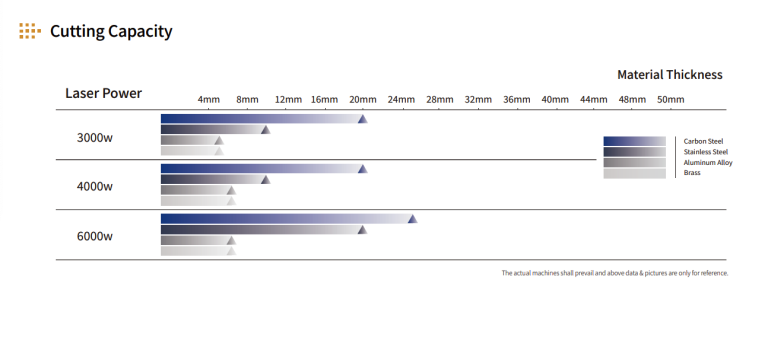
- Laser power and thickness capability: Match wattage to the majority of your workpiece thicknesses; higher power generally supports faster cutting and thicker materials but adds cost and infrastructure requirements.
- Table size / working envelope: Choose bed dimensions to handle your common sheet sizes and nesting strategies, reducing handling and cutting in multiple setups.
- Cutting speed vs. edge quality: Evaluate how the machine balances rapid traverse and cutting speeds with edge finish, especially on intricate contours and small holes.
- Positioning accuracy and repeatability: Look for specifications that support tight tolerances on complex parts, particularly if you do downstream forming or precision assembly.
- Assist gas flexibility: Confirm compatibility with the gases and pressures you intend to use (e.g., nitrogen for oxide-free edges, oxygen for faster thick cutting) and the impact on operating cost.
- Automation and material handling: Assess options like shuttle tables, automatic loading/unloading, and sorting to keep the laser cutting while minimizing idle time between sheets.
- Control system and software: Ensure the CNC, nesting, and programming tools support your file formats, part libraries, and scheduling approach, and can integrate with your existing workflow.
Buying Advice
- Define your part mix: List typical materials, thicknesses, batch sizes, and tolerances so you can match laser power, table size, and accuracy to real production needs.
- Request test cuts: Have representative parts cut on candidate machines and compare edge quality, speed, and dimensional accuracy to your current process.
- Evaluate automation needs: Decide how much loading/unloading and part sorting you require now, and confirm that the system is expandable for future automation.
- Check utility requirements: Verify that your facility can support the electrical, cooling, and assist gas demands of the chosen configuration.
- Review safety and enclosure design: Inspect guarding, interlocks, fume extraction, and operator access to ensure compliance with your safety standards.
- Assess usability: Examine control layout, programming workflow, and training materials to gauge how quickly your team can become productive.
- Understand maintenance and consumables: Clarify recommended service intervals, availability of parts, and expected consumption of nozzles, lenses, and filters.
- Plan integration: Confirm compatibility with your CAD/CAM, ERP, and quality systems, including data exchange and job tracking.
- Consider lifecycle costs: Look beyond purchase price to energy use, gas consumption, uptime, and potential productivity gains over several years.
- Verify support resources: Ensure that you will have timely access to technical support, remote diagnostics, and, where applicable, local service personnel.
FAQ
How does fiber laser cutting differ from older cutting technologies? Fiber lasers use a solid-state, fiber-delivered beam that typically offers higher efficiency, faster cutting on many materials, and reduced maintenance compared to some legacy systems.
What industries benefit most from fiber laser cutting? Any operation needing precise, repeatable metal cutting—such as general fabrication, machinery, automotive, and equipment manufacturing—can benefit from the speed and accuracy of fiber laser systems.
Is a fiber laser cutting system suitable for small batches and prototypes? Yes, provided the programming and setup workflow is efficient; the same machine can handle both short-run prototypes and high-volume production.
How important is laser power when selecting a system? Laser power directly affects cutting speed and maximum thickness capability, so it should be chosen based on the material types and thicknesses you process most often.
Can fiber laser cutting improve sustainability in my operation? These systems are designed for high energy efficiency and can reduce scrap and rework, contributing to lower overall resource consumption.
What facility changes might be required before installation? You may need to verify electrical capacity, cooling provisions, assist gas supply, and floor space for the machine and any automation modules.
How long does it take operators to learn fiber laser cutting? Learning time depends on prior CNC experience and the complexity of your parts, but modern controls are generally designed to shorten the training curve.
Does fiber laser cutting replace all other cutting processes? Not necessarily; while it can consolidate many operations, other processes may still be preferred for very thick sections or specialized materials.
What should I look for in a demonstration or factory visit? Observe real-time cutting of your parts, changeovers between jobs, nesting efficiency, and how easily operators handle routine tasks and maintenance.
How do I estimate the return on investment for a fiber laser system? Compare the total cost of ownership—including purchase, operation, and maintenance—to projected gains in throughput, labor savings, scrap reduction, and new business opportunities.
Source: Revolutionizing Industry: Fiber Laser Cutting’s Rise
Revolutionizing Industry: Fiber Laser Cutting’s Rise