Hyd-Mech’s Next-Generation S-20 Saws Put Setup Consistency on the Capital-Planning Agenda
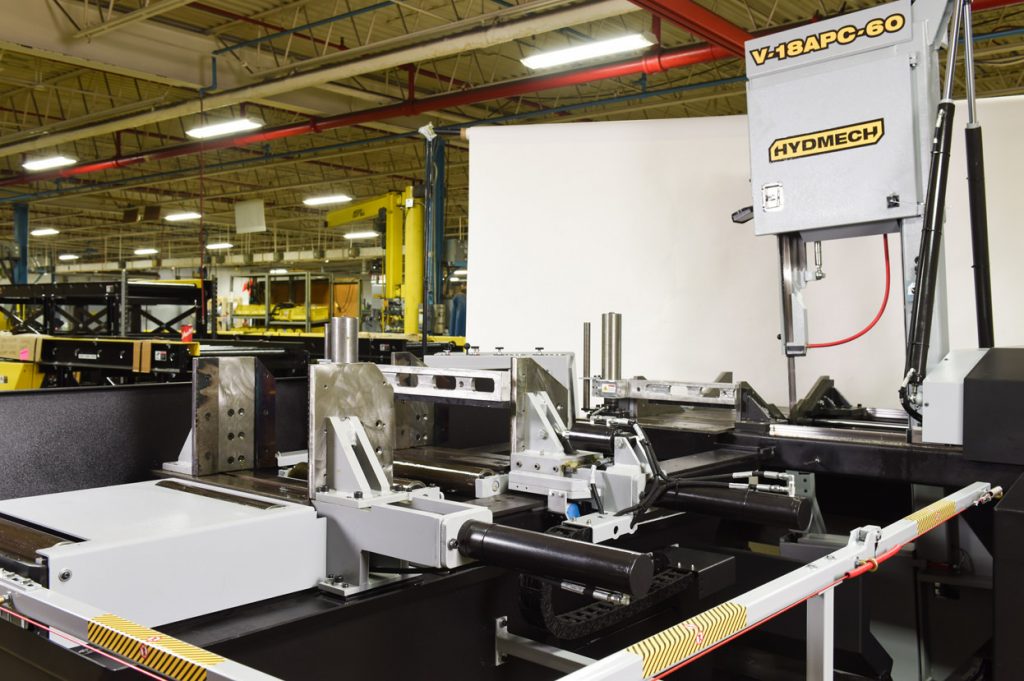
FABTECH 2026 is scheduled for October 21–23 at the Las Vegas Convention Center. Manufacturing News reports that HYDMECH plans to feature its Next Generation S-20 and S-20P horizontal pivot band saws. For a capital review, the useful question is not which label sounds more productive. It is whether the S-20P’s additional hydraulic functions address recurring work in your shop enough to justify their cost.
What the two saws share, and where they differ
Both models have a 7-inch HMI touchscreen with digital angle display and HYDMECH’s Eco-Smart mist lubrication system. HYDMECH says the mist system can use up to 90% less coolant than flood systems. Treat that figure as an OEM comparison, not a guaranteed reduction in your operation: actual consumption depends on the comparison basis, material, settings, and shop practices.
The S-20 is a manual saw: the operator manually clamps the material and lifts the saw head. The S-20P is semi-automatic and adds a hydraulic vise and a hydraulically powered head that returns automatically after each cut. The operator still loads material and supervises cutting, but these functions mechanize some repeated actions.
Those are equipment differences, not proof of a specific cycle-time, fatigue, blade-life, or labor-cost improvement. The financial value depends on how often those manual tasks recur, how your work is organized, and what a representative trial shows.
Match the added functions to actual work
Start with the cutting mix, not a projected savings percentage. If the saw makes occasional cuts across varied jobs, the manual S-20 may fit the workload. If repeated clamping and head lifting account for a meaningful share of operator time during frequent batches, the S-20P may merit evaluation. Neither conclusion should be assumed without observing the work.
- Cut frequency and batch profile: Record cuts per shift, batch sizes, and how often jobs change.
- Miter and setup work: Track time to set angles, verify settings, and recover from setup errors.
- Operator touch time and handling: Note time spent clamping, lifting the head, positioning stock, and moving completed parts.
- Material mix and fit: Check representative shapes, sizes, and materials against current capacity and configuration documentation.
- Staffing and workload: Identify whether saw tasks constrain staffing, contribute to overtime, or compete with other operator responsibilities.
- Coolant baseline: Measure current use and define the comparison method before estimating any reduction.
Run a representative-job trial before projecting ROI
Choose jobs that reflect normal production, including common materials, miter angles, and batch sizes. Agree in advance on what counts as an acceptable cut and how results will be recorded. Where practical, compare equivalent work on the existing process and candidate saw under similar conditions.
- Record setup time and total cycle time for the job.
- Measure operator touch time separately from cutting time.
- Inspect cut quality against the shop’s requirements, including angle and fit-up needs.
- Measure coolant consumption using a consistent method and comparison period.
- Document any changes in loading, unloading, staging, or downstream handling.
Confirm the proposed configuration, capacity, utilities, options, implementation needs, and quoted price with the manufacturer or dealer. The models list the same capacity figures on their product pages, but verify current specifications against your actual application and material before purchase approval.
Make the capital decision on measured evidence
I would approve the S-20P over the manual S-20 only when representative-job measurements show that its hydraulic clamping and automatic head return address enough recurring operator work to support the investment, while maintaining required cut quality and fitting the shop’s material flow. Include implementation and operating costs in the comparison. If the measured difference is small or the work mix rarely uses those functions, the simpler manual configuration may be the more disciplined choice.
Use the FABTECH showing to examine both machines and ask configuration questions, but make the business case at the shop level. A trial with agreed measures is a stronger basis for capital planning than turning supplier claims into a savings forecast.
Related Video
Structural Band Saw Unboxing – Hydmech Horizontal Pivot Band Saws