Hydmech Expands Intelligent Sawing Capabilities for High-Mix Midwest Fabricators
Midwest Fabrication Pressure in 2026
Across Illinois and Iowa, fabrication shops are balancing structural steel demand, contract metalwork variability, and heavy equipment supply chain pressure with tighter labor pools. Chicago-area structural corridors, the Quad Cities manufacturing base, and central Illinois ag equipment suppliers are all managing high-mix production with fewer experienced operators.
Sawing is often treated as a front-end task. In reality, it sets the pace for welding, machining, and forming. When cut lengths drift or setups consume too much time, every downstream process absorbs the cost.
Industry coverage from Fabricating & Metalworking continues to highlight labor shortages and the growing reliance on automation in metal fabrication. In that context, Hydmech’s emphasis on automatic and dual-column band saw platforms aligns directly with Midwest shop realities.
Hydmech’s Automation Positioning
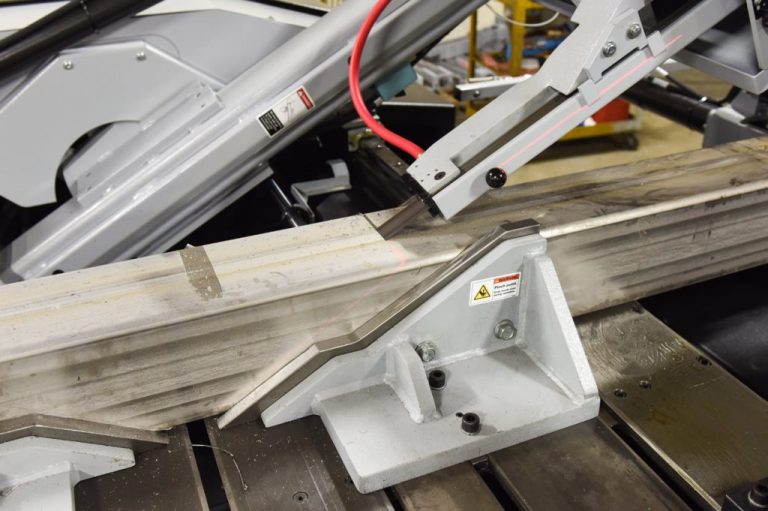
Hydmech’s automatic saw portfolio centers on horizontal and dual-column platforms designed for programmable control and repeatable indexing. According to Hydmech product documentation, automatic models are built to handle multiple indexed cuts, programmable job quantities, and consistent feed control across a range of structural shapes and tube.
This positioning reflects a shift from operator-dependent cutting toward process-controlled sawing. Instead of relying on manual measurement and frequent rechecks, programmable controls manage cut length, part counts, and feed sequences with repeatable precision.
For Midwest fabricators running mixed material profiles such as I-beams in the morning and round tube in the afternoon, that shift reduces the variability that typically shows up during high-mix transitions.
Indexing and Intelligent Controls in High-Mix Production
High-mix shops in Illinois and Iowa often move between short structural runs and medium production batches. Manual or semi-automatic saws require constant operator attention for measurement, clamping, and feed adjustments.
Automatic indexing systems reduce repeated measuring and repositioning. Programmable cut lists allow operators to load a job, confirm material, and let the saw execute consistent strokes with controlled feed pressure. Dual-column designs further stabilize the cut, helping maintain squareness and surface finish across heavier sections.
The practical impact is shorter setup time between part numbers and more predictable throughput per shift. In labor-constrained environments, intelligent controls do not eliminate skilled operators. They allow fewer operators to oversee more consistent output with less manual intervention.
Material Handling as a System, Not an Accessory
Hydmech automatic saw platforms are frequently paired with infeed and outfeed conveyors, bundle cutting fixtures, and integrated indexing systems. On the manufacturer side, automatic configurations are positioned around throughput-oriented layouts rather than standalone machines.
For structural contractors and heavy equipment fabricators, material handling drives cycle time as much as blade speed. Long stock staging, stable bundle clamping, and consistent part discharge prevent bottlenecks that can stall welding cells or press brake work centers.
In space-constrained facilities around Joliet, Rockford, Peoria, or Davenport, floor planning becomes critical. Integrating conveyors and stock supports into a defined material flow reduces forklift traffic and improves safety while supporting higher daily cut volumes.
ROI Through a Midwest Lens
For Illinois and Iowa shops, the financial case for upgrading from semi-automatic to fully automatic sawing often comes down to measurable metrics.
Throughput per labor hour improves when one operator can oversee multiple cutting cycles rather than manually feeding each cut. Scrap decreases when programmable indexing holds tighter length tolerances across batches. Blade life stabilizes when feed pressure and coolant delivery remain consistent instead of varying by operator technique.
Downstream gains are equally important. More consistent cut squareness and repeatable lengths reduce fit-up time in welding and minimize rework before machining. Over months of production, those small efficiencies compound.
Fabricating & Metalworking has noted that automation investments are increasingly evaluated against labor availability and long-term productivity stability. In that framework, intelligent sawing becomes less about speed alone and more about predictable output.
When Full Automation Makes Financial Sense
Upgrading from semi-automatic to fully automatic typically makes sense when:
- Cut lists exceed a few hundred pieces per week across multiple part numbers
- Operators spend significant time measuring and repositioning material
- Downstream departments report length variability or squareness issues
- Overtime is used to keep up with prep work
Shops focused on structural steel, mixed-alloy contract work, or heavy equipment frames often see the strongest return when sawing shifts from manual oversight to programmed, repeatable cycles.
What Midwest Buyers Should Prioritize
Before investing in an automation-ready Hydmech platform, fabrication leaders should evaluate:
- Automatic indexing accuracy and programmability for mixed job lists
- Clamping stability for structural shapes, tube, and bundle cutting
- Integration options for infeed and outfeed conveyors within available floor space
- Control simplicity for cross-shift operator consistency
- Compatibility with future automation such as automated loading or material tracking
It is also critical to review total ownership costs, including blades, coolant systems, wear components, and preventive maintenance intervals. Automation delivers ROI only when uptime is protected.
Sawing as a Strategic Throughput Lever
In high-mix Midwest fabrication environments, sawing is not just a first-step process. It is a throughput lever that influences welding flow, machining schedules, and on-time delivery performance.
Hydmech’s focus on automatic horizontal and dual-column saws with programmable controls and indexing reflects a broader industry shift toward intelligent, integration-ready equipment. For Illinois and Iowa fabricators facing labor constraints and expansion pressure, the right sawing platform can stabilize production, protect margins, and create capacity without adding headcount at the same rate as output.
Evaluated correctly, intelligent band sawing becomes a long-term operational decision rather than a simple equipment replacement.
Related Video
Structural Band Saw Unboxing – Hydmech Horizontal Pivot Band Saws